
Every month, thousands of your neighbors search for churches on Google. 2,400 searches are for "community church near me." 1,900 searches are for "small churches near me." 1,300 searches are for "church service near me."
Church keywords are simply the words and phrases people use when they're looking for a church, a service time, or help from a congregation. And here's the uncomfortable truth: most churches never appear for any of them. Not because their ministry isn't worth finding. It's because nobody ever told Google what they offer.
This article is the full list. It is grouped by category, and includes real monthly search numbers, so you can be equipped to tell Google what your church has to offer. We'll also cover a simple way to pick your first three keywords. Then you can start showing up. No jargon, no tech degree required.
What Are Church Keywords (and Why They Matter)
Church keywords fall into six categories: local searches, denominational searches, service-time searches, ministry searches, seasonal searches, and community-need searches. Each one represents a real person with a real question — often someone at a turning point in their life.
It helps to separate two very different groups of searchers. There are keywords that church staff search, like "church website builder" or "church management software." And there are keywords your future visitors search, like "non-denominational church near me." This list is about the second group — because those are the searches that fill pews.
One more reason this matters more than it used to: most first-time visitors will look at your church online before they ever walk through your doors. When they search and your church doesn't appear, they don't conclude you're humble. They conclude you're closed, dying, or not for them — and they visit the church that did show up.
The Church Keyword List — By Category
The search volumes below are US monthly averages from Semrush data (July 2026). Your local numbers will be smaller, but the patterns hold in every city.
1. Local "Near Me" Keywords — The Highest-Intent Searches
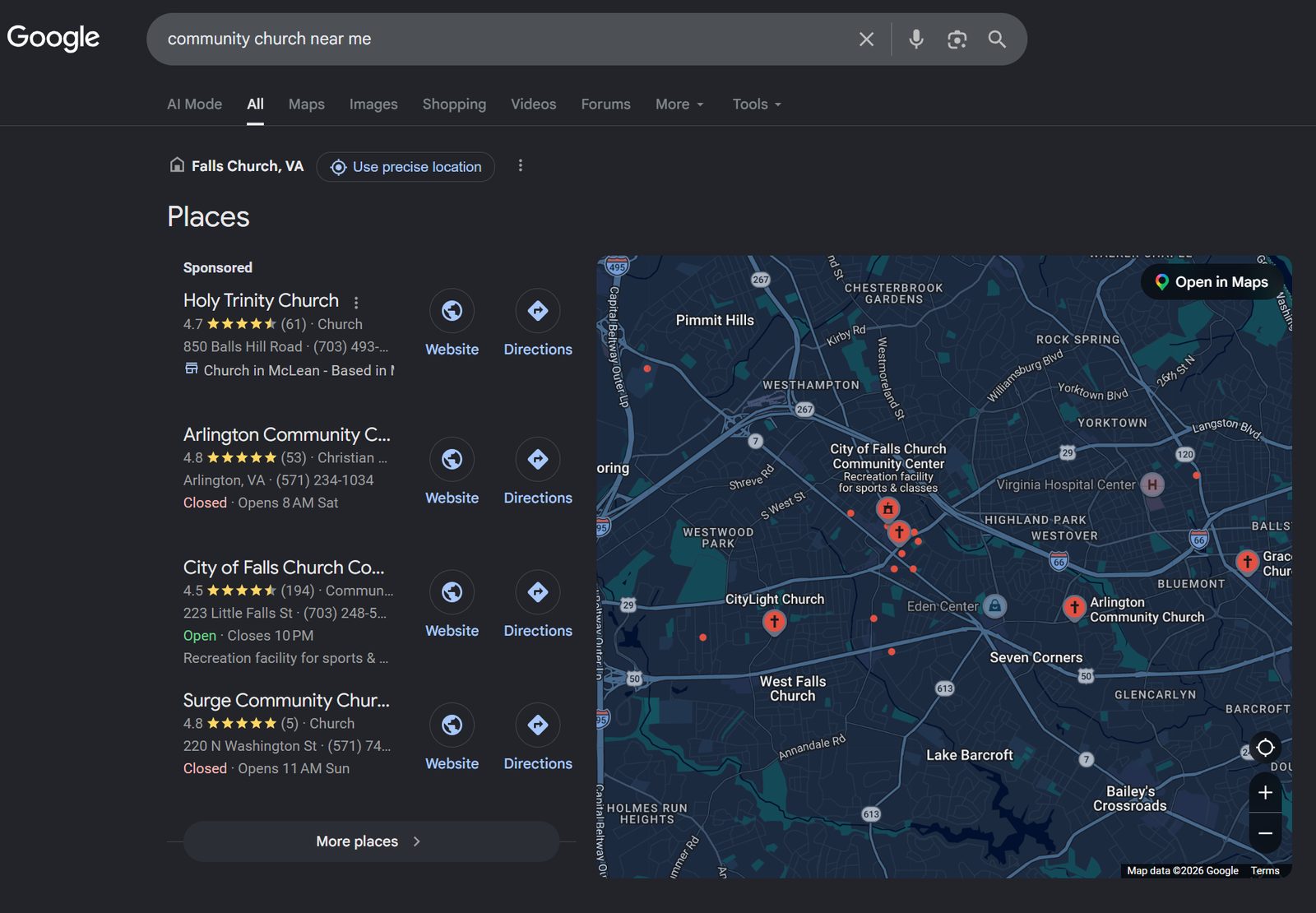
These are the crown jewels. Someone typing "church near me" on a Saturday night is very often in your building on Sunday morning.
- churches near me (and variants) — 4,400+ searches/month
- community church near me — 2,400
- protestant church near me — 2,400
- small churches near me — 1,900
- bible church near me — 1,900
- church service near me — 1,300
Notice "small churches near me" — nearly two thousand people a month are specifically looking for a smaller congregation. If you've ever felt your church was too small to compete online, that number should change your mind.
Here's the catch: "near me" searches are mostly won by your Google Business Profile (GBP), the map listing with the pins, not your website alone. Your profile needs the right categories, accurate service times, photos, and reviews. (We break it all down in our Google Business Profile guide for churches; it's also a core part of our church SEO services.) For the complete local playbook — your Google profile, your website's location signals, reviews, and local links — read our guide to local SEO for churches.
2. "[Denomination] Church in [City]" Keywords
Plenty of people search by tradition: "baptist church [city]," "lutheran church [city]," "non-denominational church [city]." These volumes are city-specific — "non denominational church kansas city" alone gets 170 searches a month, and your city has its own version of that number.
The template is simple: [your denomination or style] + church + [your city and neighboring towns]. If your church identifies as non-denominational, don't stop there — people also search "bible church," "community church," and "christian church," and those are all describing you.
3. Service Time & "This Weekend" Keywords
Searches like "church service times [city]" and "evening sunday service near me" (210/month nationally) come from people who have already decided to attend. They just need one fact.
Two rules win these searches. First, put your service times in text on your homepage — not buried in an image or a PDF flyer, which Google can't reliably read.
Second, keep them current on your Google Business Profile. I cannot stress how important relevant information on your Google profile is. A church with accurate opening times, a website, and decent reviews on their Google Business Profile will always outperform a church that hasn't claimed their profile or added any relevant information to it.
4. Ministry & Life-Stage Keywords
Parents don't search "church." They search "kids church near me" (90/month, and one of the easiest church keywords to rank for anywhere). Others search "churches with youth programs near me," "young adult ministry [city]," "women's bible study [city]."
The rule: every ministry deserves its own page. One page listing all your ministries in a paragraph can't rank for any of them. A dedicated youth page, kids page, and young-adults page — each with a description, photos, times, and a contact — can each rank for its own search. This is where good church website design and good SEO turn out to be the same project. It's also why we made ministry pages part of our must-have content for a church website.
5. Seasonal Keywords — Christmas and Easter
Twice a year, church search demand spikes: "christmas eve service near me," "easter service [city]," "good friday service times." As one proof point, seasonal searches around a single well-known church's Easter services pull 110+ searches a month on their own — multiply that pattern across every city in America.
These searches come overwhelmingly from people who don't regularly attend church. They are the largest evangelistic search opportunity on the calendar, and most churches publish their Christmas page on December 20th — weeks after the searching started. Publish your Christmas and Easter pages six to eight weeks early, keep the URL the same every year so it builds authority, and update the details annually.
6. Community-Need Keywords — Search as Ministry
This category is the one almost every keyword list misses, and it might be the most important: searches like "food pantry [city]," "grief support group near me," "marriage counseling [city]," "celebrate recovery near me."
The people typing these aren't church shopping. They're hungry, grieving, struggling, or desperate — and they're asking the whole internet for help. If your church runs a food pantry and your website doesn't have a page that says so, the person searching "food pantry [your city]" at 9pm on a Tuesday will never find you.
Ranking for community-need keywords isn't marketing. It's making sure the help your church already offers is findable by the people who need it. If your congregation is ever skeptical of "SEO," start here — this is the case that wins the board meeting.
How to Choose Your Church's 3 Starter Keywords
You don't need seventy-five keywords. You need three. Here's the formula we use with every church:
- One local keyword — "church in [your city]" or the "near me" pattern that best matches your style ("community church near me," "bible church near me").
- One denominational keyword — "[your denomination/style] church [your city]."
- One ministry or need keyword — your strongest ministry or your most visible community service ("kids church [city]," "food pantry [city]").
A quick example. Grace Fellowship is a 120-person non-denominational church in Frederick, Maryland with a strong kids program and a monthly food distribution. Their three: "non denominational church frederick md," "kids church frederick md," and "food pantry frederick md." That's a homepage focus, a kids ministry page, and a food pantry page. Small list, clear assignments, real results.
Start with three, win them, then expand.
How to Use These Keywords (Without Keyword-Stuffing)
Keywords work when they show up in the places Google reads most carefully — naturally, the way a human would write:
- Page titles and headlines. "Kids Church in Frederick, MD | Grace Fellowship" beats "Children's Department."
- Your homepage's first paragraph. Say what you are and where you are in plain words: "a non-denominational church in Frederick, Maryland."
- Your Google Business Profile — categories, description, and services.
- Dedicated pages for each ministry, each seasonal service, and each community program.
- Your FAQ text, written the way people actually ask questions.
And what not to do: don't repeat "church in Frederick MD" eleven times on one page, don't hide keywords in white text (yes, people still try), and don't sacrifice warmth for optimization. Google has gotten very good at rewarding pages that read like they were written by humans, for humans — which, for a church, should be the easy part. When you're ready to put these keywords to work page by page, run our church website SEO checklist.
Church Keyword FAQ
What are the best SEO keywords for a church?
The best keywords for most churches are local, high-intent searches: "[style] church in [city]," "church near me" variants matched to your identity, and one ministry or community-need keyword like "kids church [city]" or "food pantry [city]." Big national terms are less valuable than the searches happening in your own zip code.
How do I find keywords for my church's website?
Start with the six categories in this list and localize them to your city. Then check Google's autocomplete (type "church" plus your city and see what it suggests) and the "People also ask" boxes. For exact volumes, tools like Semrush or Google Keyword Planner help — or a professional church SEO audit will show you which keywords you already rank for and which are within reach.
How many keywords should a church target?
Three to start — one local, one denominational, one ministry/need — then grow to ten or fifteen as pages get built. Every keyword should have exactly one page assigned to it.
Do small churches need different keywords?
Mostly the same categories, with one advantage: 1,900 people a month search "small churches near me." Small churches also face less competition for neighborhood-level and ministry-specific searches, where a well-built page can outrank the megachurch across town.
Your Neighbors Are Already Searching
Every keyword in this list represents someone in your community, this month, looking for what your church already offers. The only question is whether they'll find you.
Want to know which of these keywords your church already ranks for — and which ones are one good page away? Get a free church SEO audit. We'll review your website, your Google Business Profile, and your local rankings in plain English. No commitment, no jargon — you'll know exactly where you stand.
David Graham is the founder of Five Loaves Marketing, a church marketing agency helping churches and faith-based nonprofits get found by the people searching for them.